Share this tour




Offered languages
- English
One tour, three completely different versions of Lebanon. The morning is Beirut — seafront, downtown landmarks, a mosque and cathedral sharing the same square, Roman baths in the middle of a rebuilt city, and the deliberately unrepaired Civil War facade that tells you more about this country than a week of reading. The afternoon is the Chouf Mountains — Beiteddine Palace, one of the finest 19th-century palaces in the Arab world, and Deir el Qamar, Lebanon's first capital and one of the best-preserved Ottoman villages in the country. Lunch included in Deir el Qamar. One guide connects it all.
This is the tour that answers the question most first-time visitors ask on day one: how do I see as much of Lebanon as possible in a single day without it feeling rushed? The answer is this itinerary, this guide, and a group of no more than twelve.
What's Included
Meeting and pickup
Free pickup is available from any hotel, Airbnb, or residence in Beirut.
Itinerary
-
Beirut (Pass by)
8:30 AM — Hotel pickup Your guide meets the group at your Beirut hotel. The city tour starts immediately — Pigeon Rocks is five minutes away.
Admission ticket free -
1Pigeon Rocks in Raouche
Pigeon Rocks & Zaitunay Bay The limestone sea stacks off Raouche — Beirut's most photographed natural landmark — then along the seafront to Zaitunay Bay marina. Your guide sets the geographical and historical context for the city before the downtown walk begins.
10 minutes • Admission ticket free -
Corniche Beirut (Pass by)
Drive along the Corniche el Manara — Beirut's Mediterranean promenade, the city's democratic common ground. Drive past the Holiday Inn — its Civil War facade deliberately preserved, the most honest five seconds in Beirut.
Admission ticket free -
2Downtown Beirut
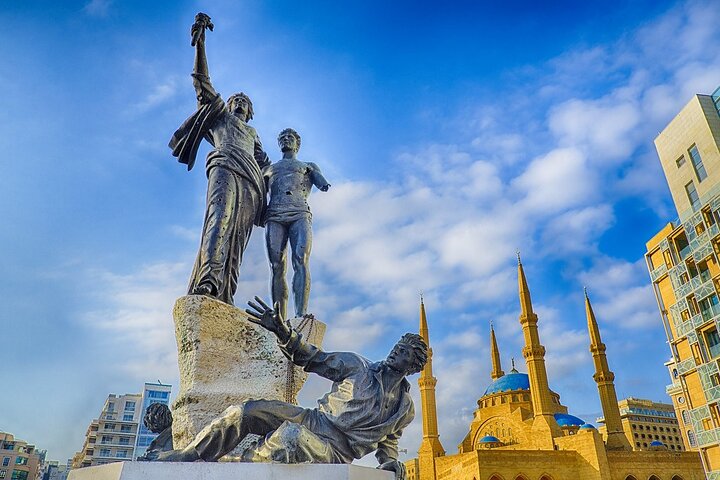
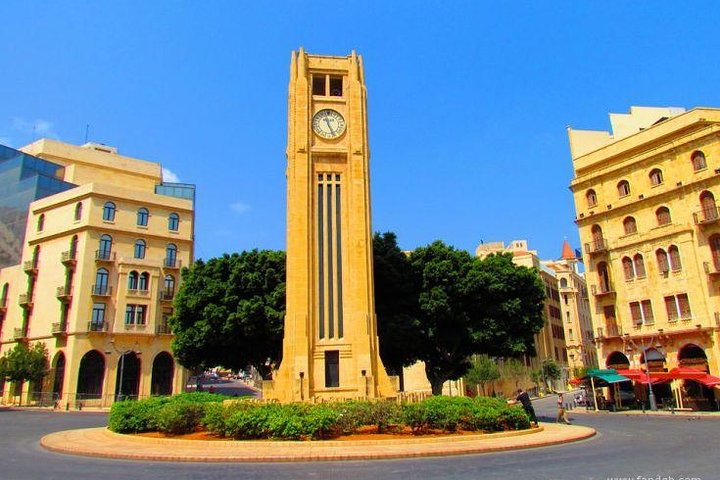
Downtown Beirut — the guided circuit Your guide leads the group through Beirut's most essential downtown stops — all within walking distance, each with a distinct story that connects to the next. Mohammad Al-Amin Mosque · 10 min ⛪ Saint George Cathedral · 10 min Martyrs' Square · 10 min Place de l'Étoile · 10 min Beirut Souks · 10 min Roman Baths · 10 min
1 hour 30 minutes • Admission ticket free -
3
Beiteddine Palace — the presidential palace of Lebanon Built between 1788 and 1840 by Emir Bashir II — the ruler who unified Lebanon's mountain factions. Three interconnected courtyards with hand-cut tilework and carved cedar-wood ceilings. Beneath the palace: Lebanon's finest collection of Byzantine mosaics — floor panels of extraordinary quality that most visitors walk straight past. Today the official summer residence of the Lebanese President. Your guide covers the full story of Beiteddine and what it represents in Lebanese political and cultural history.
1 hour • Admission ticket included -
4Deir el Qamar
Deir el Qamar — Lebanon's first capital, still going Meaning "Monastery of the Moon" — a honey-stone Ottoman village that served as Lebanon's first capital under the Ma'an dynasty and remains one of the most perfectly preserved historic villages in the country. The cobblestone square is framed by 17th and 18th-century mansions. A mosque and a church stand metres apart — four centuries of coexistence in a single hillside view. Your guide explains the political and religious significance of this village to Lebanese mountain identity.
30 minutes • Admission ticket free -
5Fakhreddine's Mosque
Fakhreddine Mosque & Saydet el Tallé Church The 17th-century mosque of Emir Fakhreddine II — the Druze ruler who built an empire from the Bekaa to the Sinai — and the hilltop Maronite church with panoramic views over the Chouf valleys. Same hillside, four centuries, two communities. Your guide explains why this matters in a country where coexistence is never accidental.
15 minutes • Admission ticket free -
6Deir el Qamar
Lunch in Deir el Qamar — included Lebanese mountain mezze at a local Deir el Qamar restaurant — grilled meats, fresh bread, Chouf valley views. Fully included in the tour price.
1 hour • Admission ticket free -
Beirut (Pass by)
Return to Beirut — approx. 5:30–6:30 PM Drop-off at your Beirut hotel. City, palace, and Lebanon's first capital — three versions of the country in one guided day.
Admission ticket free
Additional info
- Infants are required to sit on an adult’s lap
- Suitable for all physical fitness levels
Tags
Cancellation Policy
For a full refund, cancel at least 24 hours before the scheduled departure time.
Cancellation Policy
- For a full refund, you must cancel at least 24 hours before the experience’s start time.
- If you cancel less than 24 hours before the experience’s start time, the amount you paid will not be refunded.
- Any changes made less than 24 hours before the experience’s start time will not be accepted.
Rating

You can cancel up to 24 hours in advance of the experience for a full refund.
Your guide to the flawless travel experience
Popular Countries
Get our app

