Share this tour






Offered languages
- English
Kyoto First-Time Visitor Private & Personalized Walking Tour
Explore Kyoto your way with a fully private and personalized walking tour designed around your interests, travel style, and schedule. Enjoy your own English-speaking private guide for approximately 8 hours, with assistance throughout the day.
How It Works
STEP 1: Share Your Interests
Tell us where you would like to go, what you would like to see, and any special requests.
STEP 2: Plan Your Day
We’ll create a draft itinerary based on your preferences and share it with you for review.
STEP 3: Finalize Your Itinerary
We’ll make adjustments based on your feedback and confirm your final plan.
STEP 4: Enjoy Kyoto Your Way
Your private guide will accompany you throughout the day and provide recommendations along the way.
The itinerary can be adjusted during the tour if time and circumstances allow. Overtime charges apply if the tour exceeds the scheduled duration.
What's Included
Meeting and pickup
Itinerary
-
1Kinkaku-ji
Visit Kinkaku-ji, a UNESCO World Heritage Site originally built in 1397 as the retirement villa of a shogun and later converted into a Zen temple. Admire the iconic Golden Pavilion covered in gold leaf, beautifully reflected in the surrounding pond, and stroll through its serene gardens. You will also see a bonsai tree believed to be over 600 years old, adding to the timeless atmosphere of this historic site.
30 minutes • Admission ticket not included -
2Kiyomizu-dera
Visit Kiyomizu-dera, a UNESCO World Heritage Site founded in 778. Before arriving, walk through the beautifully preserved historic districts of Ninenzaka and Sannenzaka, lined with traditional shops and houses. At the temple, admire the famous 13-meter-high wooden stage, built without nails, offering panoramic views over Kyoto and a truly unforgettable cultural experience.
45 minutes • Admission ticket not included -
3Sannenzaka Ninenzaka
Visit the beautifully preserved historic streets of Ninenzaka and Sannenzaka, located in the heart of Kyoto’s traditional district. These charming stone-paved slopes date back to the Edo period and are lined with traditional wooden houses, tea shops, local sweets, and souvenir stores. Stroll through this atmospheric area, enjoy local snacks, and experience the timeless beauty of old Kyoto as you make your way toward Kiyomizu-dera Temple.
45 minutes • Admission ticket free -
4Yasaka Shrine
Visit Yasaka Shrine, one of Kyoto’s most famous Shinto shrines, founded over 1,350 years ago. Located at the edge of the historic Gion district, the shrine is known for its vibrant vermilion gates and beautiful lantern displays. It is also the starting point of the famous Gion Matsuri, a tradition that has been celebrated for over 1,100 years, held every July and considered one of Japan’s most important festivals. Stroll through the lively grounds and experience Kyoto’s rich cultural and spiritual heritage.
30 minutes • Admission ticket not included -
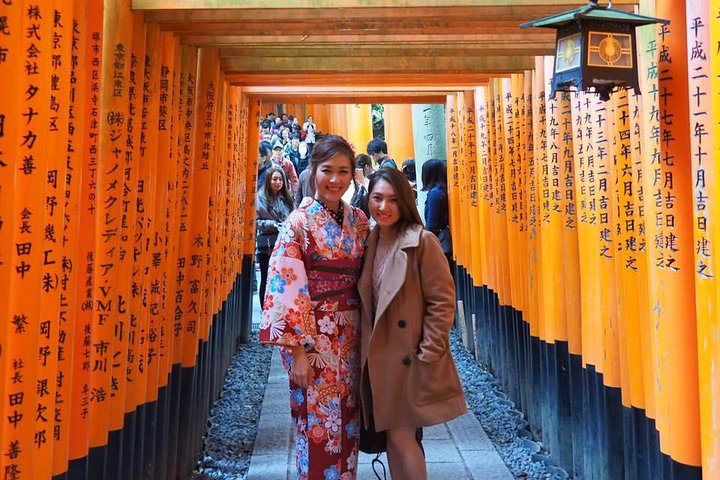
5Fushimi Inari-taisha Shrine
Visit Fushimi Inari Shrine - the Ultimate Torii Gate Experience - an important Shinto shrine famous for its thousand of vermillion Torrid fates which straddle a network of trails behind its main building.
15 minutes • Admission ticket free -
6Arashiyama
Visit Arashiyama - the second most sightseeing district in Kyoto since Heian Period filled with temples, shrines and bamboo gives. 1. Bamboo Forest 2. Tenryuji Temple - Kyoto's five Zen Temples founded in 1339. UNESCO World Heritage Site. 3. Togetsu Bridge - Moon crossing bridge - built during the Heian Period reconstructed recently in 1930s
1 hour • Admission ticket not included -
7Nishiki Market Shopping District
Visit Nishiki Ichibe - a narrow, five block long shopping street lined bemire than one hundred shops and restaurants known as Kyoto's kitchen.
40 minutes • Admission ticket free -
8Gion
Visit Gion - Kyoto's famous geisha district
30 minutes • Admission ticket free -
9Ginkakuji Temple
Visit Ginkakuji - the Silver Pavilion - built by Yoshimitsu's grandson, Ashikaga Yoshima, on the other side of the City a few decades after Kinkakuji.
30 minutes • Admission ticket not included -
10Sanjusangendo Temple
Sanjusangendo (三十三間堂, Sanjūsangendō) is the popular name for Rengeo-in, a temple in eastern Kyoto which is famous for its 1001 statues of Kannon, the goddess of mercy. The temple was founded in 1164 and rebuilt a century later after the original structure had been destroyed in a fire. Measuring 120 meters, the temple hall is Japan's longest wooden structure. The name Sanjusangendo (literally "33 intervals") derives from the number of intervals between the building's support columns, a traditional method of measuring the size of a building. In the center of the main hall sits a large, wooden statue of a 1000-armed Kannon (Senju Kannon) that is flanked on each side by 500 statues of human sized 1000-armed Kannon standing in ten rows. Together they make for an awesome sight.
30 minutes • Admission ticket not included -
11Kyoto Imperial Palace
The Kyoto Imperial Palace (京都御所, Kyōto Gosho) used to be the residence of Japan's Imperial Family until 1868, when the emperor and capital were moved from Kyoto to Tokyo. It is located in the spacious Kyoto Imperial Park (京都御苑, Kyōto Gyoen), an attractive park in the center of the city that also encompasses the Sento Imperial Palace and a few other attractions.
30 minutes • Admission ticket free -
12Nijo Castle
Nijo Castle (二条城, Nijōjō) was built in 1603 as the Kyoto residence of Tokugawa Ieyasu, the first shogun of the Edo Period (1603-1867). His grandson Iemitsu completed the castle's palace buildings 23 years later and further expanded the castle by adding a five story castle keep.
45 minutes • Admission ticket not included -
13Eikando Zenrinji Temple
Eikando (永観堂, Eikandō), formally known as Zenrinji Temple, belongs to the Jodo sect of Japanese Buddhism. Located just north of the large temple complex of Nanzenji, Eikando is very famous for its autumn colors and the evening illuminations that take place in fall. The temple has a long history, and there are a variety of buildings and a pond garden that visitors can explore. A court noble of the Heian Period (710-1185) donated his villa to a priest, who converted it into a temple under the name Zenrinji (lit. "temple in a calm grove"). At its founding, Zenrinji was part of the Shingon sect and its first head priest was a disciple of the great Kobo Daishi, the sect's founder.
45 minutes • Admission ticket not included
Additional info
- Wheelchair accessible
- Infants and small children can ride in a pram or stroller
- Public transportation options are available nearby
- Infants are required to sit on an adult’s lap
- Not recommended for travelers with spinal injuries
- Not recommended for pregnant travelers
Additional info
- Wheelchair accessible
- Infants and small children can ride in a pram or stroller
- Public transportation options are available nearby
- Infants are required to sit on an adult’s lap
- Not recommended for travelers with spinal injuries
- Not recommended for pregnant travelers
- Not recommended for travelers with poor cardiovascular health
- Suitable for all physical fitness levels
Tags
Cancellation Policy
All sales are final. No refund is available for cancellations.
Cancellation Policy
This experience is non-refundable and cannot be changed for any reason. If you cancel or ask for an amendment, the amount you paid will not be refunded.
Rating

You will not receive a refund if you cancel.
Your guide to the flawless travel experience
Popular Countries
Get our app

