Share this tour



Offered languages
- English
One of the famous Indian tourist circuits is the Golden triangle, which includes Delhi, Agra and Jaipur. A tour through this route provides a great overall view of India’s variant landscapes, and gives an opportunity to see many great cultural jewels of the country.
Delhi, the largest metropolis is divided mainly into two parts-New Delhi and Old Delhi. One can witness a blend of culture, sophistication and history.
While Agra is well known for housing the Taj Mahal, an epitome of eternal love, Jaipur is famous its majestic havelis, forts and markets. In this tour we give you a glimpse of the rich heritage and culture of the subcontinent.
What's Included
Breakfast
Meeting and pickup
Delhi Airport OR Railway Station OR Centrally located Hotel
Itinerary
-
1Qutub Minar
You will be assisted with check in at the hotel on arrival at Delhi, by our staff member, followed by sightseeing in the afternoon and an evening spent in leisure. The sightseeing tour will include a visit to India’s tallest stone tower-Qutub Minar, along with a tour of India Gate, Rashtrapati Bhavan- the Presidential House, Red Fort, and Jama Masjid. India Gate is a place built specially in commemoration of all the soldiers who tragically lost their lives in the Anglo-Afghan war and World War.
1 hour • Admission ticket not included -
India Gate (Pass by)
The India Gate was part of the work of the Imperial War Graves Commission (I.W.G.C), which came into existence in December 1917 for building war graves and memorials to soldiers who were killed in the First World War
-
Rashtrapati Bhavan (Pass by)
Is the official residence of the President of India located at the Western end of Rajpath in New Delhi, India. Rashtrapati Bhavan may refer to only the 340-room main building that has the president's official residence, including reception halls, guest rooms and offices, also called the mansion; it may also refer to the entire 130-hectare (320 acre) Presidential Estate that additionally includes huge presidential gardens (Mughal Gardens), large open spaces, residences of bodyguards and staff, stables, other offices and utilities within its perimeter walls. In terms of area, it is the largest residence of any head of state in the world.
-
2Red Fort
Constructed in 1639 by the fifth Mughal Emperor Shah Jahan as the palace of his fortified capital Shahjahanabad, the Red Fort is named for its massive enclosing walls of red sandstone and is adjacent to the older Salimgarh Fort, built by Islam Shah Suri in 1546 AD. The imperial apartments consist of a row of pavilions, connected by a water channel known as the Stream of Paradise (Nahr-i-Bihisht). The fort complex is considered to represent the zenith of Mughal creativity under Shah Jahan
1 hour • Admission ticket not included -
3Jama Masjid
It was built by the Mughal Emperor Shah Jahan between 1650 and 1656 at a cost of one million rupees, and was inaugurated by Imam Syed Abdul Ghafoor Shah Bukhari from Bukhara, present-day Uzbekistan. The mosque was completed in 1656 AD with three great gates and two 40 metres high minarets constructed with strips of red sandstone and white marble. The courtyard can accommodate more than 25,000 people. There are three domes on the terrace which are surrounded by the two minarets. On the floor, a total of 899 black borders are marked for worshippers. The architectural plan of Badshahi Masjid, built by Shah Jahan's son Aurangzeb at Lahore, Pakistan, is similar to the Jama Masjid.
1 hour • Admission ticket not included -
4Chandni Chowk
The Chandni Chowk (meaning Moonlight Square) is a street market square it is one of the oldest and busiest markets in Old Delhi, India. Located close to the Old Delhi railway station, the Mughal-era Red Fort is located at the eastern fringes of Chandni Chowk. It was built in 1650 by the Mughal Emperor, Shah Jahan, and designed by his daughter, Jahanara. The street spanning the market was historically divided by canals, engineered to reflect moonlight. These canals have since been closed, leaving behind a transformed urban landscape. It remains one of India's largest wholesale markets
1 hour • Admission ticket free -
5Humayun's Tomb
Humayun's Tomb in Delhi, built in 1570, is a UNESCO World Heritage site and the first1570, is a UNESCO World Heritage site and the first garden-tomb on the Indian subcontinent, representing a masterpiece of 16th-century Mughal architecture. Commissioned by Empress Bega Begum, this red sandstone structure features a Persian-inspired charbagh layout and served as a major inspiration for the Taj Mahal
1 hour • Admission ticket not included -
6
We set out on a road trip to Agra in the morning, followed by check in at the hotel. Spend the afternoon soaking in the beauty of the Taj Mahal followed by shopping in the evening. The Taj Mahal a classic example of Mughal art is the tomb of Mumtaz Mahal, wife of Emperor Shah Jahan. It took him 22 years and over 20,000 labourers and over 32 crores, to build the monument dedicating it to his beloved wife
3 hours • Admission ticket not included -
7Agra Fort
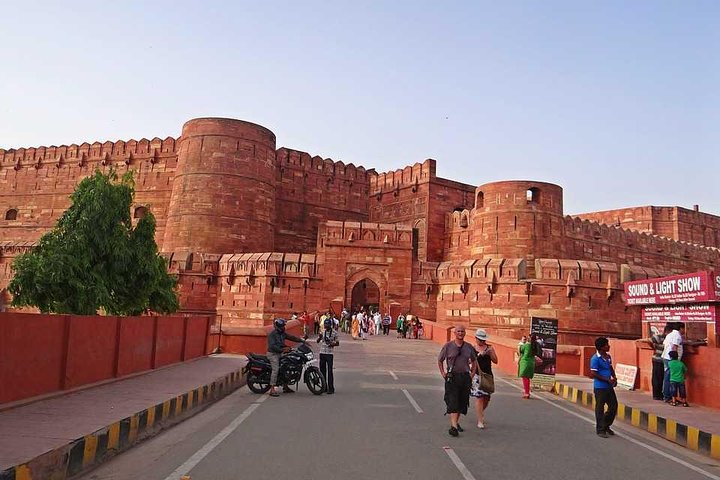
Agra Fort is a historical fort in the city of Agra in India. It was the main residence of the emperors of the Mughal Dynasty until 1638, when the capital was shifted from Agra to Delhi. Before capture by the British, the last Indian rulers to have occupied it were the Marathas. In 1983, the Agra fort was inscribed as a UNESCO World Heritage site. It is about 2.5 km northwest of its more famous sister monument, the Taj Mahal. The fort can be more accurately described as a walled city.
1 hour • Admission ticket not included -
8Panch Mahal - Fatehpur Sikri
Drive to the next destination- Jaipur in the morning. We make an en-route visit to the former capital of the Mughals, Fatehpur Sikri. On arrival in Jaipur after check-in at the hotel, spend the remaining day at leisure. Fatehpur Sikri formerly known as Sikrigarh is a fort made using red sandstone. The architecture blends composite cultures of indigenous and foreign origins in an Indo-Muslim composite style.
1 hour • Admission ticket not included -
9Buland Darwaza
Buland Darwaza or the "Door of victory", construction was started in 1573 by Mughal emperor Akbar to commemorate his victory over Gujarat. It is the main entrance to the Jama Masjid at Fatehpur Sikri, which is 43 km from Agra, India. Buland Darwaza is the highest gateway in the world and is an example of Mughal architecture. It displays sophistication and heights of technology in Akbar's empire
1 hour • Admission ticket not included -
10Jama Masjid
The Jama Mosque, also known as the Jama Masjid, is a 16th-century Sufi Friday mosque and dargah complex, in the UNESCO World Heritage Site of Fatehpur Sikri, located in the Agra district of the state of Uttar Pradesh, India. It was built by Mughal emperor Akbar, and was the largest mosque in the empire at the time of construction. The Jama Masjid's design drew from earlier mosques built by various pre-Mughal sultanates, and served as an important precedent in subsequent Mughal architecture.
30 minutes • Admission ticket not included -
11Jaipur
On arrival at the Jaipur city check in at the Hotel. Rest of the evening will be at leisure
1 day • Admission ticket free -
12Amber Palace
We visit the Amber fort in the morning. This fort was built in the 16th century, and is counted among the oldest forts of Rajasthan. We drive to the Hawa Mahal which literally means Palace of the Breeze. We then visit the City Palace and museum in the afternoon, followed by a visit to the Jantar Mantar observatory. Leisurely spend the evening.
1 hour • Admission ticket not included -
13Jantar Mantar - Jaipur
Jantar Mantar, the largest sundial in the world, is a World Heritage Site and definitely a must-not-miss on your trip to Jaipur. A guided tour (30 minutes to 1 hour) is recommended, and would cost Rs. 100.
1 hour • Admission ticket not included -
14City Palace of Jaipur
Once the seat of Jaipur’s Maharaja and today a rich museum, the main citadel of Jaipur’s City Palace is a marriage of Mughal and Rajput architecture. The Palace complex is home to historical attractions like Mubarak Mahal, Chandra Mahal, Diwan-I-Khas, Diwan-I-Aam and Maharani Palace.
1 hour • Admission ticket not included -
15Laxmi Narayan Temple
The Laxmi Narayan Temple is more commonly referred to as the Birla Temple and it pays tribute to Lord Narayan in his various forms. The intricate carvings and the magnificent structure make the Birla Temple an artistic masterpiece. The special light effects at night, which augment the beauty of the pure white marble a thousand times over, should certainly not be missed.
1 hour • Admission ticket not included -
16Albert Hall Museum
One of the oldest museums in Jaipur, it is also known as Government Central Museum and was built by Maharaja Sawai Ram Singh II in 1868. Boasting of the Indo-Saracenic architecture, the design of the museum is quiet similar to the Victoria and Albert museum in London. The museum building includes many archways, towers and courtyards which boast of a rich architecture. Inside the museum, a vast collection of artefacts like miniature paintings, tribal costumes, jewellery, weapons, clay sculptures, metal and ivory ware, ceramics, musical instruments and marble statues are on display.
1 hour • Admission ticket not included -
Jal Mahal (Pass by)
Literally meaning as ‘Water Palace’, Jal Mahal is located amidst the Man Sagar Lake and was constructed by Sawai Pratap Singh in the year 1799. The beauty of the palace lies in its location as the palace cum hotel is standing in the centre of the lake. The palace architecture boasts of a typical Rajput and Mughal style which is quite similar to that of Amer Fort. Made in red sandstone, the palace is actually five-storeyed where only the top story is visible (rest are submerged under water).
-
17Hawa Mahal - Palace of Wind
The Hawa Mahal is a palace in the city of Jaipur, Rajasthan, India. Built from red and pink sandstone, it is on the edge of the City Palace, Jaipur, and extends to the Zenana, or women's chambers. Hawa Mahal, also known as the “palace of winds“ was built in 1799 by the Maharaja Sawai Pratap Singh. It is considered unique as it has many small windows and balconies that seem like a honeycomb. The structure was built in 1799 by the Rajput Emperor Maharaja Sawai Pratap Singh, grandson of Maharaja Sawai Jai Singh, the founder of the city of Jaipur of Rajasthan. He was so inspired by the unique structure of Khetri Mahal that he built this grand and historical palace.
30 minutes • Admission ticket not included -
New Delhi (Pass by)
The morning after breakfast depart from Jaipur Hotel to catch a flight or train for the onward journey or you can drive back to Delhi and can further take flight or train from Delhi for your onward journey. (Jaipur-Delhi drive minimum 05 Hours so plan accordingly)
Delhi-Arrival
Delhi-Agra-by Car
Agra-Jaipur-By Car
Jaipur-Sightseeing
Jaipur/Delhi-Departure
Additional info
- Wheelchair accessible
- Infants are required to sit on an adult’s lap
- All areas and surfaces are wheelchair accessible
- Not recommended for travelers with spinal injuries
- Not recommended for travelers with poor cardiovascular health
- Travelers should have at least a moderate level of physical fitness
Additional info
- Wheelchair accessible
- Infants are required to sit on an adult’s lap
- All areas and surfaces are wheelchair accessible
- Not recommended for travelers with spinal injuries
- Not recommended for travelers with poor cardiovascular health
- Travelers should have at least a moderate level of physical fitness
- Children must be accompanied by an adult
- Note: Although Gala dinner is not included in this product, please note that on December 24th, 25th or 31st the Gala Dinner may be mandatory for most of the hotels in India
Tags
Cancellation Policy
For a full refund, cancel at least 24 hours before the scheduled departure time.
Cancellation Policy
- For a full refund, you must cancel at least 24 hours before the experience’s start time.
- If you cancel less than 24 hours before the experience’s start time, the amount you paid will not be refunded.
- Any changes made less than 24 hours before the experience’s start time will not be accepted.
Rating

You can cancel up to 24 hours in advance of the experience for a full refund.
Your guide to the flawless travel experience
Popular Countries
Get our app