Share this tour




Offered languages
- English
The sunrise at Angkor Wat is considered one of the most spectacular and iconic sunrises in the world. Its uniqueness comes from the combination of ancient architecture, natural light, and spiritual atmosphere.
The Sun Rises Behind the Temple
Unlike many landmarks, the sun rises directly behind Angkor Wat's five lotus-shaped towers during much of the year. As dawn breaks, the temple appears as a dramatic silhouette before gradually glowing in the warm morning light.
The Famous Reflection
The two lotus ponds in front of the western entrance create one of the world's most recognizable reflections. When the water is still, the temple and colorful sunrise are mirrored perfectly, creating a breathtaking composition for photographers.
Ever-Changing Colors
Each sunrise is different. The sky may glow with shades of deep blue, purple, pink, orange, red, and gold, making every morning a unique experience.
What's Included
Meeting and pickup
You may provide your hotel address after confirming your accommodation booking in Siem Reap City. On the day of your tour, please wait for us in the lobby of your hotel, where your guide and driver will meet you before departure around 15 minutes.
Itinerary
-
1Angkor Wat
Angkor Wat is the largest and most famous Khmer temple, built in the 12th century, between 1113 -1150, during the reign of Suryavarman II. Standing 65 meters high, the temple is surrounded by a large moat [Ko Tek]. The exterior and interior walls are covered with amazing base-reliefs.
2 hours • Admission ticket not included -
2Bayon Temple
PRASAT BAYON or ANGKOR THOM is a Buddhist style temple built in late 12th/early 13th century by Jayavarnam VII. Bayon has 54 towers representing the 54 provinces before and during the Khmer empire. There are over 200 smiling faces carved on the 54 towers. Bayon was a thriving capital but unfortunately was damaged in 1811 by Cham invaders.
2 hours • Admission ticket free -
3Chau Say Tevoda
Chau Say Tevoda is a temple at Angkor, Cambodia. It is just east of Angkor Thom, directly south of Thommanon across the Victory Way. Built in the mid-12th century, it is a Hindu temple in the Angkor Wat period. It is dedicated to Shiva and Vishnu with unique types of female sculptures of devatas enshrined in it.
30 minutes • Admission ticket not included -
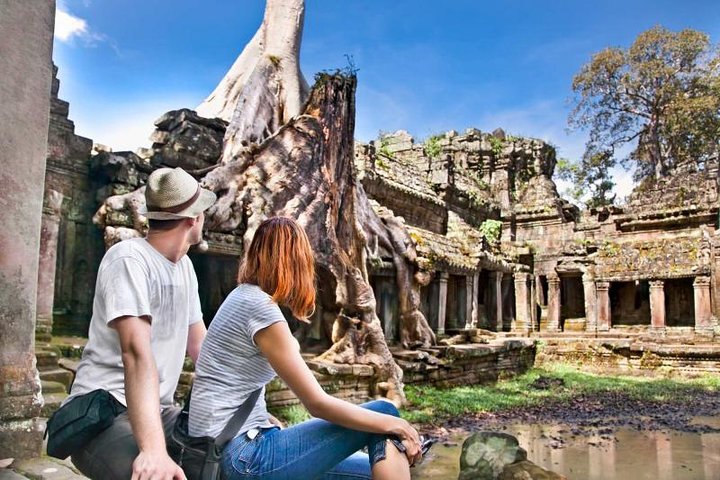
4Ta Prohm Temple
PRASAT TA PROMH, built in late 12th century by Jayavarman VII was dedicated in 1186 to his mother. Originally this temple had a Buddhist background but later was converted to Hindu so some Buddhist galleries were destroyed and replaced by Hindu symbols such as Yoni and Lingam. Its location is 1.5kms from Bayon through the Victory Gate. Ta Promh is famous for the trees (called “Spung”) growing strongly up, on and over the sandstone block walls.
2 hours • Admission ticket free -
5Ta Nei Temple
Ta Nei is a late 12th century stone temple in Angkor, Cambodia. Built during the reign of King Jayavarman VII, it is near the northwest corner of the East Baray, a large holy reservoir. It was dedicated to the Buddha.
35 minutes • Admission ticket not included -
6Bayon Temple
The South Gate is one of five grand entrances to the ancient city of Angkor Thom, built in the late 12th century and is the best-preserved and most famous gate. It is known for its impressive causeway lined with statues of gods (devas) and demons (asuras) pulling a naga, as well as a gate tower with four faces similar to those at the Bayon temple. This gate serves as a ceremonial and defensive entrance, and the causeway is a popular spot for photographs and the start of elephant rides into the city.
35 minutes • Admission ticket free
Additional info
- Suitable for all physical fitness levels
Tags
Cancellation Policy
For a full refund, cancel at least 24 hours before the scheduled departure time.
Cancellation Policy
- For a full refund, you must cancel at least 24 hours before the experience’s start time.
- If you cancel less than 24 hours before the experience’s start time, the amount you paid will not be refunded.
- Any changes made less than 24 hours before the experience’s start time will not be accepted.
Rating

You can cancel up to 24 hours in advance of the experience for a full refund.
Your guide to the flawless travel experience
Popular Countries
Get our app

