Share this tour




Offered languages
- German
- English
- Italian
- French
- Spanish
Experience India's Golden Triangle Tour 4 Day Tours covers the 3 most prominent tourist destinations in the heartland of India. This tour is a combination of the most Glorious and the most Charming cities: Delhi -The Political and Cultural Hub of India, Agra -The Epitome of Love, and Jaipur -The Pink City as well as the first planned city of India. This tour represents the Grandeur, Glory, and History of the true Indian Diverse Culture. This tour offers one of the finest cultural experiences in India along with a visit to some of the finest monuments and UNESCO World Heritage Sites including the Taj Mahal in Agra. You will visit the fortresses, palaces, monuments, and much more.
* Marvel at the stunning architectural wonders of Agra
* Gaze in awe at one of the Seven Wonders of the World
* Stroll through the Red Fort, Itimad-Ud-Daulah Tomb
* Admire the pastel hues from the Pink City of Jaipur
* Bask in the magnificence of the grand Taj Mahal
What's Included
Breakfast
Meeting and pickup
Hotel/Airport/Railway Station/or your desired location in Delhi/Noida/Gurgaon.
Itinerary
-
1Jama Masjid
The Masjid-i-Jehan-Numa, commonly known as the Jama Masjid of Delhi, is one of the largest mosques in India. It was built by the Mughal Emperor Shah Jahan between 1650 and 1656.
1 hour • Admission ticket included -
2Chandni Chowk
In the heart of Old Delhi, Chandni Chowk is a busy shopping area with markets full of spices, dried fruit, silver jewelry and vivid saris, while the narrow side streets are crowded with tiny shops selling essential oils, stationery and traditional Indian sweets. Nearby, the vast Mughal-era Red Fort.
1 hour • Admission ticket free -
3Old Delhi Rickshaw Ride
Enjoy a Rikshaw Ride in Old Delhi. It dates back to 1638, when Emperor Shahjahan shifted his capital from Agra to Delhi. His daughter Jahanara constructed a square, around which a busy market grew. Today, It's home to silversmiths, repair shops, clothiers, spicy street food vendors and traditional sweetmeat shops. We will explore not just the bazaar, but also the cultural landscape of this area in a cycle rickshaw.
30 minutes • Admission ticket included -
Red Fort (Pass by)
The Red Fort is a historic fort in the city of Delhi in India. It was the main residence of the emperors of the Mughal dynasty for nearly 200 years, until 1856. It is located in the centre of Delhi and houses a number of museums.
-
4Qutub Minar
Qutub Minar is a UNESCO World Heritage site which was established by Qutub-ud-din Aibak, the founder of Delhi Sultanate, in 1193. It contains spiral staircase and it's design is thought to be based on the Minaret of Jam.
1 hour • Admission ticket included -
5Lotus Temple
Lotus Temple is a magnificent attraction of the city due to the unique flower-like shape. It was built in 1986. It has won many architectural awards and has also been featured in many newspapers and magazines. It has also been declared as the most visited building in the world.
30 minutes • Admission ticket free -
India Gate (Pass by)
India Gate is a war memorial located near the Rajpath. It is dedicated to the soldiers of British India who died in the wars. The India Gate, even though a war memorial, evokes the architectural style.
-
Parliament House (Pass by)
Parliament Housealso known as the Sansad Bhavan consists of the the two houses/assemblies of India, Lok Sabha and Rajya Sabha. The shape of the building is based on The Ashoka Chakra ( circular ) and is surrounded by lush green gardens which makes the view even more spectacular.
-
Rashtrapati Bhavan (Pass by)
Rashtrapati Bhavan is the official place where the President of India resides. Presidential Estate additionally includes huge presidential gardens, large open spaces, residences of bodyguards and staff, stables and other offices.
-
6Humayun's Tomb
The Humayun's tomb is the tomb of the Mughal Emperor Humayun in Delhi, India. The tomb was commissioned by Humayun's chief consort, Empress Bega Begum, in 1558.
1 hour • Admission ticket included -
7Taj Mahal
Watch the sun rise over the Taj Mahal, Take a guided tour inside the Taj Mahal for approximately two hours, as your guide shares its history as a tomb built by Mughal Emperor Shahjahan in 1630 to enshrine his wife. It's a declared winner of the New 7 Wonders of the world, is a UNESCO World Heritage. Yamuna river gives a phenomenal background and the green gardens enhances the beauty of the monument. Return back to your hotel to enjoy breakfast, check out from hotel and visit Agra Fort.
2 hours • Admission ticket not included -
8Agra Fort
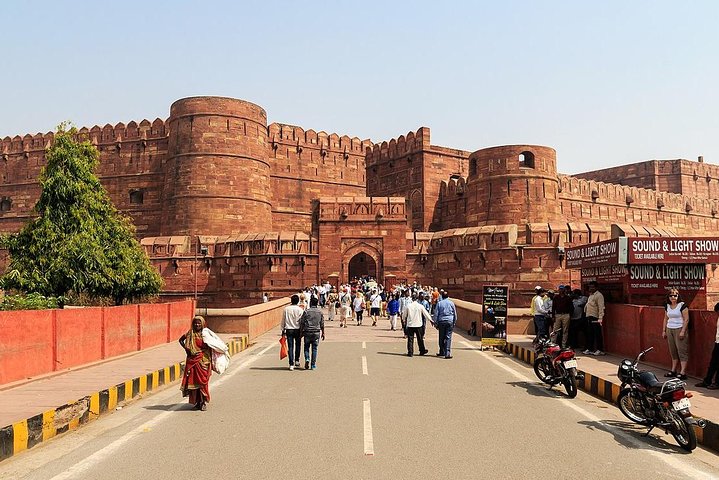
Visit Agra Fort as your guide reveals the marvels of its palaces, balconies, and gardens. It's another UNESCO World Heritage site, is a historical fort in the city of Agra. It was the main residence of the Mughal Emperors. This fort contains various other sites which have the same historical impact and makes one aware of the magnificent history of India.
1 hour • Admission ticket not included -
9Itmad-ud-Daula
Tomb of I'timād-ud-Daulah is a Mughal mausoleum in the city of Agra in the Indian state of Uttar Pradesh. Often described as a "jewel box", sometimes called the "Bachcha Taj", the tomb of I'timād-ud-Daulah is often regarded as a draft of the Taj Mahal.
30 minutes • Admission ticket not included -
10Jaipur
After your tour of Agra, head to Jaipur. Upon arrival, check in to your hotel and take some time to relax. Overnight Hotel in Jaipur.
4 hours • Admission ticket free -
11Panna Meena ka Kund
After Breakfast, take a guided sightseeing tour of Jaipur city. Visit Panna Meena ka Kund, It's a step well.
15 minutes • Admission ticket free -
12Amer
Visit Amer situated on the top of the hill. It was built by Raja Man Singh I. It is known for its artistic elements. The Maota Lake located in front of the monument acts as a source of water for the fort.
2 hours • Admission ticket free -
13Jal Mahal
Jal Mahal is a palace located in the middle of the Man Sagar Lake in the city of Jaipur. The palace was renovated and enlarged by Maharaja Jai Singh II of Amber in the 18th century. The palace and scenic beauty of the lake attracts various tourists.
30 minutes • Admission ticket free -
14City Palace of Jaipur
City Palace of Jaipur was constructed in 1721 and originally was the administrative and ceremonial seat of Maharaja of Jaipur. Many religious and cultural events of that time took place in the palace. It now consists of the Maharaja Sawai Man Singh II Museum, and continues to be the home of the Jaipur royal family.
1 hour • Admission ticket included -
15Jantar Mantar - Jaipur
Jantar Mantar is a UNESCO World Heritage site built in 1734. It is a collection of nineteen architectural astronomical instruments built by the Rajput king Sawai Jai Singh II, the founder of Jaipur. The instruments allow the
1 hour • Admission ticket included -
16Hawa Mahal - Palace of Wind
Hawa Mahal also known as The Palace of Winds is made with the red and pink sandstones which makes it distinguished from the surroundings. The architecture of the Mahal attracts numerous tourists. The palace is a five-storey pyramidal shaped monument and was built by Sawai Pratap Singh in 1799. During the tour you will have time for lunch at a local restaurant.
15 minutes • Admission ticket free -
17Gaitore Ki Chhatriyan
Gaitore Ki Chhatriyan is a serene royal cremation site featuring intricately carved cenotaphs of Jaipur’s former Maharajas. Nestled in a peaceful valley, it beautifully blends Rajput architecture with tranquil surroundings.
20 minutes • Admission ticket free -
18
After breakfast, make the approximately five-hour journey back to Delhi or be dropped-off at Jaipur airport.
5 hours • Admission ticket included
Arrive Delhi - Delhi Sightseeing - Agra
Agra Sightseeing (Taj Mahal during Sunrise) - Jaipur
Jaipur City Tour
Jaipur - Delhi Departure
Additional info
- Not recommended for travelers with spinal injuries
- Not recommended for pregnant travelers
- Not recommended for travelers with poor cardiovascular health
- Suitable for all physical fitness levels
- The duration of transfers are approximate; the exact duration will depend on the time of day and traffic conditions.
- Avoid any clothing that is too revealing.
Additional info
- Not recommended for travelers with spinal injuries
- Not recommended for pregnant travelers
- Not recommended for travelers with poor cardiovascular health
- Suitable for all physical fitness levels
- The duration of transfers are approximate; the exact duration will depend on the time of day and traffic conditions.
- Avoid any clothing that is too revealing.
- Rooms are generally provided on a twin-sharing basis at each booking. In a booking of 3 people, rooms are provided on triple-sharing basis by default. If 3 guests prefer 2 rooms, they will have to pay an additional charge.
- A current valid passport is required on the day of travel.
- In case your hotel/pick up location is not mentioned while making the booking – please click on My Hotel Is Not Listed option on the Booking Checkout Page and then manually enter your Hotel Name
- On 4th day you will be back to Delhi by around 2pm, if you would like to reach early or late then you may let us know, we could plan accordingly
- Your guides help you to buy entrance tickets at the monuments, so you don't have to wait in que to buy the entrance tickets.
- If you start the tour on Thursday, then Tour itinerary will be like this, Delhi - Jaipur - Agra - Delhi, because Taj Mahal Remain closed on every Friday
- The duration of transfers are approximate; the exact duration will depend on the time of day and traffic conditions
- This is a private tour/activity. Only your group will participate
Tags
Cancellation Policy
For a full refund, cancel at least 24 hours before the scheduled departure time.
Cancellation Policy
- For a full refund, you must cancel at least 24 hours before the experience’s start time.
- If you cancel less than 24 hours before the experience’s start time, the amount you paid will not be refunded.
- Any changes made less than 24 hours before the experience’s start time will not be accepted.
Rating

You can cancel up to 24 hours in advance of the experience for a full refund.
Your guide to the flawless travel experience
Popular Countries
Get our app

