Share this tour




Offered languages
- English
If you only have one day to spend outside Beirut, this is the itinerary most travelers wish they had booked. Jeita Grotto — a UNESCO tentative World Heritage Site and finalist in the New 7 Wonders of Nature — is 30 minutes from your hotel and unlike anything you have seen before. Harissa gives you 650 metres of altitude gain by cable car and one of the most photographed views in the Middle East. Byblos has been continuously inhabited for over 7,000 years — longer than almost any city on earth — and a specialist guide makes sure you actually understand what you are looking at.
Small group of maximum 12. Professional guide throughout. Lunch at a waterfront Byblos restaurant included. Admission tickets payable at each site — no hidden costs, no surprises.
What's Included
Meeting and pickup
Free pickup is available from any hotel, Airbnb, or residence in Beirut.
Itinerary
-
Beirut (Pass by)
8:30 AM — Hotel pickup Your guide meets the group at your Beirut hotel. Jeita Grotto is 30 minutes north — the day starts immediately.
Admission ticket free -
1Jeita Grotto
TJeita Grotto — New 7 Wonders finalist · UNESCO tentative site Two cave systems that most visitors rank as the highlight of their entire Lebanon trip. The upper cave on foot — stalactites and stalagmites up to 8 metres tall, carved by water over millions of years. The lower cave by silent electric boat along an underground river — a level of stillness and scale that photos simply do not capture. Your guide covers the geological story throughout. Thirty minutes from Beirut. Nothing in the region compares.
1 hour 30 minutes • Admission ticket included -
2
Harissa cable car — Jounieh Bay from 650 metres Board the Téléférique at Jounieh and ride to 650 metres above sea level — Jounieh Bay spreading below you, the Lebanese mountains ahead. The view on the way up is the reason people come back to Harissa. Your guide points out the coastal landmarks as you ascend.
20 minutes • Admission ticket not included -
3The Shrine of Our Lady of Lebanon
Our Lady of Lebanon — the shrine that defines the skyline The 8.5-metre bronze statue of Our Lady of Lebanon — arms toward the Mediterranean, visible from the coast below. One of the most visited religious sites in the Middle East, revered by Christians and Muslims alike. The Maronite Basilica surrounds it. Your guide explains why Harissa matters to Lebanese identity far beyond its religious significance.
30 minutes • Admission ticket free -
4Byblos Castle
Byblos — 7,000 years of continuous settlement Arrive in Byblos — one of the oldest continuously inhabited cities on earth, the city whose Phoenician script gave the world its alphabet, and whose name gave us the word Bible. Your guide covers the full span of the site — Neolithic foundations from 5000 BC, Bronze Age temples, Phoenician royal tombs, Roman streets, and the 12th-century Crusader castle built from recycled Phoenician and Roman stone. Without a guide, Byblos is impressive. With a good one, it is one of the most revelatory historical experiences in the Mediterranean.
1 hour • Admission ticket included -
5Byblos
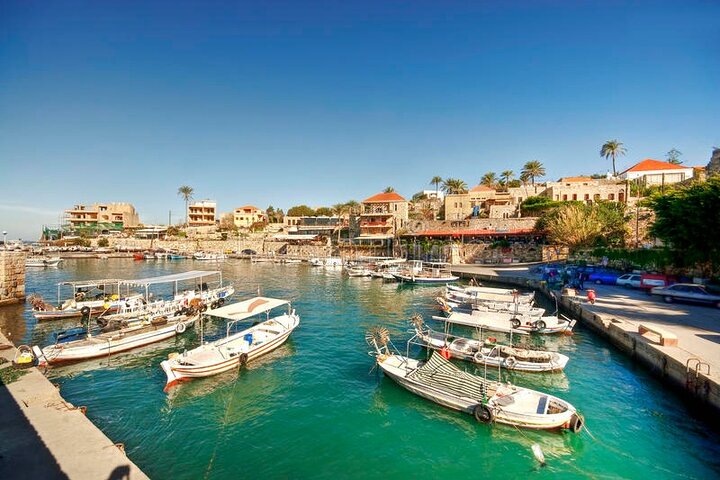
Lunch in Byblos — waterfront restaurant · included Lebanese mezze and fresh seafood at a waterfront Byblos restaurant — the ancient fishing harbour directly in front of you. One of the best lunch settings in Lebanon. Fully included in the tour price.
1 hour • Admission ticket free -
6Old Souk
Byblos Old Souk & fishing port Stone-paved lanes with jewellery workshops, antique dealers, and cafés — then down to the ancient fishing harbour. Medieval walls, colourful wooden boats, open sea. The most photogenic ten minutes in Byblos.
30 minutes • Admission ticket free -
Beirut (Pass by)
Return to Beirut — approx. 5:00–6:00 PM Drop-off at your Beirut hotel. Jeita Grotto, Harissa, and 7,000 years of Byblos — the day most travelers wish they had booked first.
Admission ticket free
Additional info
- Infants are required to sit on an adult’s lap
- Suitable for all physical fitness levels
Tags
Cancellation Policy
For a full refund, cancel at least 24 hours before the scheduled departure time.
Cancellation Policy
- For a full refund, you must cancel at least 24 hours before the experience’s start time.
- If you cancel less than 24 hours before the experience’s start time, the amount you paid will not be refunded.
- Any changes made less than 24 hours before the experience’s start time will not be accepted.
Rating

You can cancel up to 24 hours in advance of the experience for a full refund.
Your guide to the flawless travel experience
Popular Countries
Get our app

