Share this tour




Offered languages
- Japanese
- English
Food and drink are a window into Japan's history, culture, and everyday life. That's why this experience begins not at the bar, but on the streets of Asakusa.
Before enjoying food and drinks, join a history walk that reveals the bigger story of Japan. Discover how the Sumida River is linked to Senso-ji's origin, how the temple and Asakusa grew together, how the area pioneered Japan's modernization, and how its popular culture influenced the wider world.
Then step into three distinctive izakaya and discover another side of Asakusa: the world of ordinary people. For generations, Asakusa was both a religious center and an entertainment district where people gathered to eat, drink, and socialize—a spirit that lives on today.
With your guide providing cultural context, you won't simply visit three bars. You'll experience how the history you discovered on Asakusa's streets continues in the places where locals eat, drink, and unwind today.
What's Included
Meeting and pickup
The meeting place is in front of a Burger King restaurant right next to Exit 4 of Asakusa subway station (G19) on the Ginza line. Please step outside when you reach Exit 4. See below for details. https://bit.ly/3KBlIr5
Itinerary
-
1Sumida Park
This bridge has been one of the most important and popular rivers in Tokyo. Actually, the story of Sensoji temple originated in this river 1400 years ago.
15 minutes • Admission ticket free -
2Asakusa Culture Tourist Information Center
After viewing Tokyo Sky Tree and Sumida river, we will stroll to the Culture Center. Have a preview of the tour route by seeing Asakusa from high up in this building designed by a well-known Japanese architect.
15 minutes • Admission ticket free -
3
Kaminarimon (Thunder Gate) is the entrance to the world of Buddhist temple and Shinto shrine. The world's well-known giant red lantern is hanging under the gate.
15 minutes • Admission ticket free -
4Nakamise Shopping Street (Kaminarimon)
This street leads to Sensoji temple. You may be surprised by its friendly and welcoming atmosphere walking on it if you had imagined solemn and stately religious facilities. The street features not just shops but "history tablets," which recounts Asakusa's history with beautiful pictures.
15 minutes • Admission ticket free -
5Hozomon
Hozomon ("Treasure-House Gate") is the inner of two large entrance gates that ultimately leads to the Sensoji (the outer being the Kaminarimon). A two-story gate, the Hozomon's second story houses many of the Sensoji's treasures. The first story houses two statues, three lanterns and two large sandals.
15 minutes • Admission ticket free -
6Senso-ji Temple
The main part of the tour will begin as you get to know Sensoji, Tokyo's oldest temple and an essential sightseeing spot from your well-informed guide. You'll start at the Kaminarimon or 'Thunder Gate', a symbol of Asakusa, then navigate Nakamise-dori, marvel at the 'Treasure House Gate', and finally enter the temple's expansive main grounds, with plenty of history and secrets to uncover along the way. After completion of this portion of the tour, we will head for a Japan's traditional izakaya restaurant to enjoy dinner with a 2-hour all-you-can-drink.
15 minutes • Admission ticket free -
7Asakusa Shrine
This is a shrine of Shinto, Japan's indigenous religion sitting just next to Senshoji temple. Coexistence of two distinct religions in the same premises may be unfathomable. The guide will unlock the mystery from a historical standpoint.
15 minutes • Admission ticket free -
8Asakusa Demboin-dori
After the magnificence of Sensoji, we'll escape into the Rokku area: Asakusa's traditional entertainment district, always bustling yet rarely busy. Walk through the Meiji period into the present day (with stops along the way for more Japanese sweet snacks). Once a district of endless novelty — movies, comedians and exotic animals — Rokku passed through its glory days to become a quaint neighborhood of handicrafts and nostalgia. Through vivid descriptions of its complex, colorful history, you'll even see sights that aren't there to see anymore! Packed with cosy bars, eateries, and snack stands, as well as boutique shops for traditionally crafted goods of all kinds, the narrow, winding and wandering streets of Rokku will lead you through the other Asakusa experience.
15 minutes • Admission ticket free -
9Asakusa
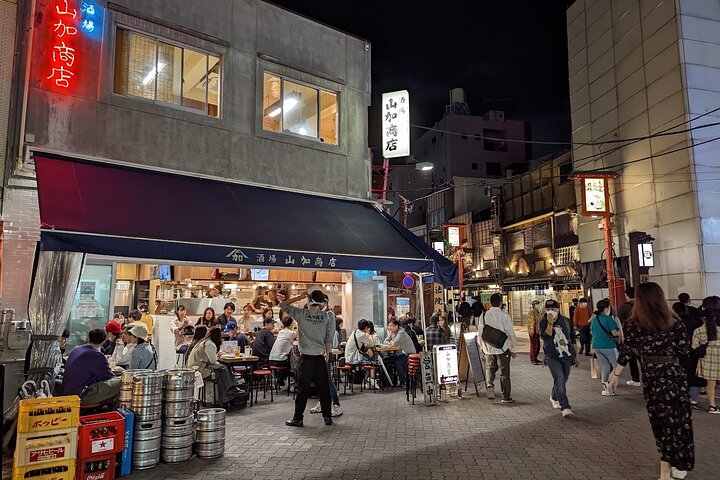
The first izakaya visit is to the Hoppy Street. This 80-meter street is lined up by izakayas with lanterns and outdoor street-side seating. They are open day and night but become festive and lively especially after dark with happy customers. Their typical offerings are Hoppy and stew made from beef tendons and vegetables. Both are cheap and come from the post-war era when people could not afford decent meals or beer. Hoppy is a a beverage with a taste similar to beer but a very low alcohol content. It is typically mixed with shochu to make a cocktail. People back then substituted Hoppy for beer. Nowadays many enjoy the nostalgic atmosphere there and rediscover the charm of their offerings.
40 minutes • Admission ticket free -
10Asakusa
We are now heading to Kamiya Bar - almost a legend in that the bar was established in 1880 making it the oldest Western-style bar in Japan. However, quite unlike the way its name sounds, it is actually a Western-style izakaya which caters to locals in a friendly and raucous setting as typical izakayas do. Since its inception, its specialty cocktail "denkiburan"- literally means electric brandy - has been a centerpiece of its offerings and loved by many. When the cocktail was invented, electricity symbolized modernization. Therefore, electricity meant everything modern that was adored. Enjoy denkiburan - a sweet blend of wine, gin and brandy - whose recipe has been and is still now a secret.
40 minutes • Admission ticket free -
11Asakusa
The last izakaya we visit specializes in sake with incredible varieties in stock. The guide will help you understand key factors about sake such as ... 1) Why it developed in Japan. 2) Which ingredients play a key role to make good sake. 3) What are key differences in the production process between sake and wine. 4) What determines its grades. Taste several types of sake. Discover how distinctly different it is in terms of its appearance, aroma, texture, and flavor. Toward the end of this tour, you will find what types of sake suit your taste.
40 minutes • Admission ticket free
Additional info
- Infants and small children can ride in a pram or stroller
- Service animals allowed
- Public transportation options are available nearby
- Infants are required to sit on an adult’s lap
- Suitable for all physical fitness levels
Tags
Cancellation Policy
For a full refund, cancel at least 24 hours before the scheduled departure time.
Cancellation Policy
- For a full refund, you must cancel at least 24 hours before the experience’s start time.
- If you cancel less than 24 hours before the experience’s start time, the amount you paid will not be refunded.
- Any changes made less than 24 hours before the experience’s start time will not be accepted.
- This experience requires a minimum number of travelers. If it’s canceled because the minimum isn’t met, you’ll be offered a different date/experience or a full refund.
- This experience requires good weather. If it’s canceled due to poor weather, you’ll be offered a different date or a full refund.
Rating

You can cancel up to 24 hours in advance of the experience for a full refund.
Your guide to the flawless travel experience
Popular Countries
Get our app

