Share this tour



Offered languages
- Portuguese
- English
- French
- Spanish
On this tour, you'll walk underground times, among ruins and columns, enter a thousand-year-old market, and cross an island on Rome's oldest bridge: it'll be a fun experience.
Is it true that every church in Rome is built on the ruins of pagan temples? You'll find out by visiting the city's most famous sites and underground passages. A few steps away, between the Portico of Octavia and the ruins of the Teatro Marcello, you'll cross Rome's oldest bridge, dating back 2,000 years and still standing! And there you are on Tiber Island; then the underground house of Saint Cecilia awaits, with its ancient mosaics, mysterious inscriptions, and richly decorated crypt. The tour continues with a visit to the Basilica Church of San Francesco a Ripa, Rome's first Franciscan church, the place, now a sanctuary, where Saint Francis stayed. The tour ends with a visit to the Basilica of Santa Maria in Trastevere, the first official place of Christian worship in Rome.
What's Included
Meeting and pickup
Meeting point
in the city center
Itinerary
-
1
Meeting point tour
15 minutes • Admission ticket free -
2Teatro di Marcello
The Theater of Marcellus, largely preserved, is the only ancient theater remaining in Rome. Built in the southern area of the Campus Martius known as the Circus Flaminius, between the Tiber river and the Capitoline Hill, it was commissioned by Caesar and continued by Augustus. The building was erected in Campo Marzio, in the place that tradition had consecrated to stage performances, where the "Theatrum et proscenium ad Apollinis", connected to the temple of Apollo, was already located.
15 minutes • Admission ticket free -
3Isola Tiberina
The Tiber Island, the only urban island on the Tiber, approximately 300 meters long and approximately 90 meters wide, is connected to the banks of the Tiber by two bridges: towards Trastevere by the Cestio bridge, dating back to 46 BC. C. and in the direction of the Ghetto with the Fabricio bridge, built in 62 BC. C., also called Quattro Capi bridge, for the Roman herms that decorate its parapets. According to legend, the island was born in 509 BC. when, having ousted Lucius Tarquinius Superbus, the last king of Rome, the people, as a sign of hatred towards the tyrant, threw the king's enormous grain deposit into the Tiber, which turned out to be so abundant that it formed a small island. In reality, a compact bank of tuff, similar to that of the nearby Capitoline Hill, constitutes the basic geological element, on which the sands carried by the current have naturally settled.
20 minutes • Admission ticket free -
4Il Portico Di Ottavia
The Portico d'Ottavia complex is the only one preserved of the large porticoes that limited, on the northern side, the square of the Circo Flaminio, an area that corresponds to the ancient Ghetto. It was rebuilt by Augustus, in place of the older Portico of Metello, between 27 and 23 BC. and dedicated to her sister Ottavia. It was subsequently restored and partially rebuilt in 203 by Septimius Severus, after a fire in 191, a period to which the majority of the currently visible remains belong. The complex, a quadriportico of 119 x 132 metres, included the most ancient Temple of Juno Regina, which was then joined by the Temple of Jupiter Stator, the first in Rome entirely made of marble, two libraries, Greek and Latin, and the Curia Octaviae , a large environment for public meetings.
15 minutes • Admission ticket free -
5Santa Cecilia in Trastevere
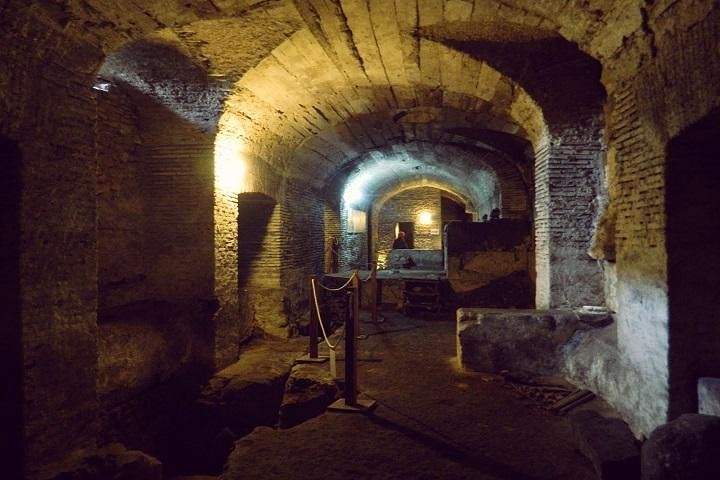
The Basilica of S. Cecilia in Trastevere is located in the square of the same name and stands on the house of the Roman martyr Cecilia and her husband Valeriano. The excavations under the church, carried out during the restoration of 1899, highlighted a group of ancient buildings from the Republican age with walls in opus quadratum of tuff and a Doric column. At the bottom of a niche there is a tuff relief representing "Minerva" in front of an altar. The building shows restorations and renovations from a later period, from the 2nd to the 4th century AD, when it was unified with other existing buildings dating back to the Republican age. In addition to various rooms built in brickwork and with remains of floor mosaics, there is also a large room characterized by the presence of seven cylindrical brick basins in the floor.
45 minutes • Admission ticket included -
6Basilica di Santa Maria in Trastevere
The Basilica was likely the first official place of Christian worship in Rome. According to legend, it was built by Pope Callixtus I in the 3rd century and completed by Saint Julius I in 340. Rebuilt during the pontificate of Pope Innocent II, it subsequently underwent decorations and restorations, including notable ones promoted by Pope Clement XI (1702) and Pope Pius IX (1870), without the church undergoing substantial alterations.
30 minutes • Admission ticket included -
7Chiesa di San Francesco a Ripa Grande
The Church of San Francesco a Ripa is a place of great spirituality in the heart of Rome, in Trastevere. This beautiful Baroque church preserves, in a simple corner, the cell, now a sanctuary, where Saint Francis was welcomed during the Roman days of papal visits.
30 minutes • Admission ticket included
Additional info
- Not recommended for travelers with poor cardiovascular health
- Travelers should have at least a moderate level of physical fitness
- This tour is intended as a walk which enters underground areas and places of worship: Should anyone feel uncomfortable in underground spaces, the guide can deal with it; those people will comfortably sit in the top church, while the rest of the group will visit the underground. It is advisable to wear confortable shoes such as sport trainers and to respect the churches dress code: trousers should touch the knee and shoulders should be covered; tourists may consider bringing a scarf to wear at necessity.
- Provide the Correct address of your accommodation , hotel, B&B
- Provide the correct phone number with international country code
- check that you provide all the details to the agency
Additional info
- Not recommended for travelers with poor cardiovascular health
- Travelers should have at least a moderate level of physical fitness
- This tour is intended as a walk which enters underground areas and places of worship: Should anyone feel uncomfortable in underground spaces, the guide can deal with it; those people will comfortably sit in the top church, while the rest of the group will visit the underground. It is advisable to wear confortable shoes such as sport trainers and to respect the churches dress code: trousers should touch the knee and shoulders should be covered; tourists may consider bringing a scarf to wear at necessity.
- Provide the Correct address of your accommodation , hotel, B&B
- Provide the correct phone number with international country code
- check that you provide all the details to the agency
- Without this information we can not guarantee the correct service
- Emergency number also operational via whatsapp- One day before 24 H. Call to confirm the pick up
- Hotel pickup and drop-off (central Rome only)
- Coronavirus information: Below a brief list of the measures will be taken to ensure the safety of customers during the tours and on board our vehicles: - gloves and surgery masks; - disinfectant gel - Sanitization of vehicles at the end of each tour - staff, assistants, guides, drivers wearing masks and gloves - preventive information to the customer once on board the vehicles - the capacity of minivans and groups will be regulated according to the law and regulations of the virus corona in customer protection
Tags
Cancellation Policy
For a full refund, cancel at least 24 hours before the scheduled departure time.
Cancellation Policy
- For a full refund, you must cancel at least 24 hours before the experience’s start time.
- If you cancel less than 24 hours before the experience’s start time, the amount you paid will not be refunded.
- Any changes made less than 24 hours before the experience’s start time will not be accepted.
Rating

You can cancel up to 24 hours in advance of the experience for a full refund.
Your guide to the flawless travel experience
Popular Countries
Get our app

