Share this tour





Offered languages
- Japanese
- English
Gujo Hachiman is famous for its pure, natural water and summer obon dance called the Gujo Odori, which has been held for over 400 years. You will experience the waterways by walking through the town and visiting the many canals and springs that are still in use today.
In this tour, your knowledgeable licensed local guide will accompany you on your journey features an atmospheric townscape, an old fashioned castle town whose culture continues to thrive like the waters of the nearby river.
Let us know what you would like to experience and we will customize your six-hours special tour that's best for you!
Note*1: Please select your must-see spots from a list in the tour information to create your customized itinerary.
Note*2: The National Government Licensed Guide Interpreter certification is issued by the Japanese government requires a good knowledge and understanding of Japanese culture and history.
What's Included
Meeting and pickup
This private tour is a walking day tour. A private vehicle is not included. Public transportation or local taxis maybe used to transfer between sites. Exact transportation costs can be discussed with the guide after a reservation is finalized. Please have Japanese Yen on hand for your transportation costs. If you wish to arrange for a private vehicle, please contact us directly. All Private vehicles must be booked 5 days in advance. Maximum number of passengers: 7.
Itinerary
-
1
The origin of Gujo Hachiman Castle was a battle base constructed by the samurai lord, Morikazu Endo, in 1559. Afterwards, the Inaba and Endo Clans expended a lot of effort to maintain the fort and in 1667 the 6th-generation castle master, Tsunemoto Endo, undertook a huge renovation. Finally, the Tokugawa shogunate admitted it as an official castle.
1 hour • Admission ticket not included -
(Pass by)
Kajiya machi and Shokunin machi were historically home to the town's craftsmen such as blacksmiths, coopers and carpenters. The houses in these streets feature workshops on the main floor facing the street, with living accommodation above. A few carpenters and tradesmen still live and operate their businesses in this district. Kajiya machi flows into Shokunin machi, which is anchored by Cho Kyo ji temple. Houses on the west side of the street back on to the Kodara River.
Admission ticket free -
(Pass by)
There used to be a natural spring along Kodara River, near Miyagase Bridge. Cold in summer and warm in winter, the water was an important blessing from nature for the local people. The water was so clear that it was often called Shimizu (pure water), too. It is said that Sogi Iio, the grand master of Japanese poetry lived at this place in the 15th century. It was selected as first place by the former Minister of Environment of the Best 100 Spring Waters in Japan.
Admission ticket free -
2
Sogi Sui water spring is the site where fifteenth century poet Sogi and local feudal lord To Tsuneyori exchanged farewell poems when the poet returned to Kyoto after visiting Gujo Hachiman. The water spring and small shrine are recognized by the Japanese Ministry of Environment for both ecological and historical significance. Sogi Sui is also listed as one of Japan's 100 Remarkable Waters, a list whose purpose is to raise public awareness of natural water and nature conservation. Selection criteria for Japan's 100 Remarkable Waters include history, uniqueness, and local people's effort to protect the sources and are not limited to water quality and preservation of surrounding environment.
15 minutes • Admission ticket free -
(Pass by)
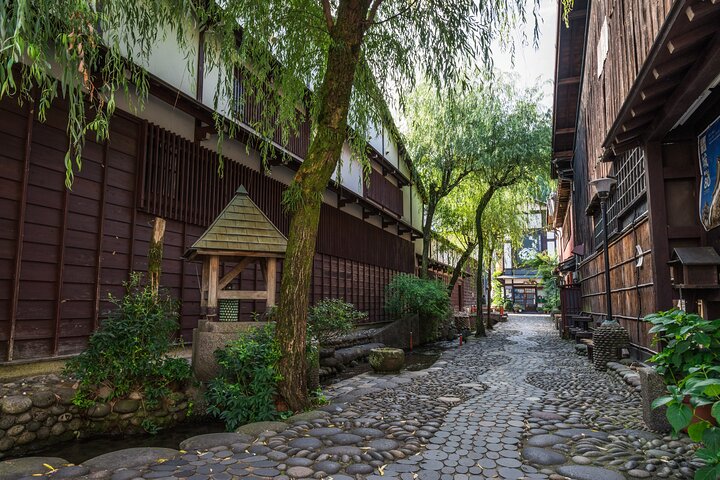
Taking a single turn from a bustling main street and walking into this little lane will soothe your heart with its beautiful gravel-covered road (using about 80,000 natural gravel stones from the Nagara and Yoshida Rivers; the number is associated with the name of the town, Gujo Hachiman, which includes the number “eight” in its name in Japanese), a water canal, swaying willow trees and a massive samurai residence. There are two museums along the street: Saito Museum and Yudokan Museum.
Admission ticket free -
(Pass by)
By the Former Gujo Hachiman Town Hall Memorial Museum, there is a pretty small canal where Koi carp and fish swim happily. The canal runs through the town, just behind the private houses, and is where one can find a basket in the water with ayu sweet fish kept inside in summer. There is also an old washing place where local housewives come together and do washing while enjoy chatting with each other.
Admission ticket free -
3
The building was built in the Taisho period (1912-1926) and was used as a former tax office. Keeping its historical atmosphere, it welcomes visitors as a museum today where people can learn about history, tradition, the water environment and Gujo Odori Dance under the theme of “The Hometown of Water, Dance and People’s Heart.” A Gujo Odori Dance performance is held five times a day on weekdays (11:00, 12:00, 13:00, 14:00, 15:00) and seven times a day on weekends (additional shows at 10:00 and 16:00).
1 hour • Admission ticket not included -
4
Housed in an historical building characteristic of typical Edo period machiya style architecture, and designated as a registered tangible cultural property, this museum showcases the tea ceremony utensil masterpieces collected by the Saito family over many generations.
30 minutes • Admission ticket not included -
5
This art museum is on the Yanaka Mizu-no-Komichi Canal, a tourist spot in Hachiman-cho, Gujo City, Gifu Prefecture. It's the personal art museum of Masao Mizuno, a local painter who produced the picture of the Gujo-odori Dance used for the Furusato Stamp series (stamps picturing local Japanese traditions). They present work in an array of genres like oil painting and wood carving, as well as exhibits with Japanese paper dolls depicting the local Gujo-odori dance and the procession of a feudal lord. The museum sells artwork and holds craft making workshops too.
30 minutes • Admission ticket not included
Additional info
- Wheelchair accessible
- Infants and small children can ride in a pram or stroller
- Service animals allowed
- Public transportation options are available nearby
- Transportation options are wheelchair accessible
- All areas and surfaces are wheelchair accessible
Additional info
- Wheelchair accessible
- Infants and small children can ride in a pram or stroller
- Service animals allowed
- Public transportation options are available nearby
- Transportation options are wheelchair accessible
- All areas and surfaces are wheelchair accessible
- Suitable for all physical fitness levels
- This is a walking tour. Pick up is on foot.
Tags
Cancellation Policy
All sales are final. No refund is available for cancellations.
Cancellation Policy
This experience is non-refundable and cannot be changed for any reason. If you cancel or ask for an amendment, the amount you paid will not be refunded.

You will not receive a refund if you cancel.
Your guide to the flawless travel experience
Popular Countries
Get our app

