Share this tour



Offered languages
- German
- English
- Spanish
Vienna is a mirror: a city with imperial muscle memory, catastrophic misjudgment, and a remarkable post‑war reinvention.
This private walk connects Vienna’s highlights with the turning points that shaped modern Austria - from the Anschluss to liberation, occupation, neutrality, and the city’s role as a bridge between East and West. Belvedere Hill, the Soviet Memorial, Heldenplatz, the Hofburg, Judenplatz, and St. Stephen’s Cathedral anchor a route that blends beauty with context.
For cineasts:
The Third Man, Lady in Gold, Mission: Impossible, Rogue Nation, Red Sparrow - four different windows into Vienna’s wartime scars and Cold War shadows.
Why travelers choose this walk:
• From your doorstep - stress‑free meeting and orientation in your temporary home
• Public transportation - sustainable, empowering, part of our Vienna experience
• Three personal hours with a local - close‑up, conversational, never scripted
• Explore Vienna with a Viennese - nuance, context, and lived perspective
What's Included
Meeting and pickup
Tour starts at 09:00/09:30/10:00 and 13:30/14:00
We meet our guests at all hotels and vacation rentals in town, at Reichsbruecke pier or train stations (Vienna Hbf, Vienna West)
Other meeting points can be arranged.
A´Rosa Gäste treffen wir am jeweiligen Pier Handelskai 265, 1020 Wien
Itinerary
-
1Jardines de Belvedere
At Upper Belvedere we begin with Vienna’s most generous panorama. Built by Prince Eugene, a military genius who never ruled, the palace became the symbolic birthplace of Austria’s Second Republic in 1955. From imperial ambition to post‑war neutrality — the shift is visible right from the terrace.
20 minutes • Admission ticket free -
Lower Belvedere (Pass by)
Belvedere Gardens & Lower Belvedere - descending the baroque garden axis, we read the landscape as a political statement: order, hierarchy, and the aesthetics of power.
Admission ticket free -
2Schwarzenbergplatz
Soviet War Memorial - at Schwarzenbergplatz, the 1945 Soviet Monument honors the thousands of Red Army soldiers who died ending Nazi rule in Vienna. A reminder that liberation and occupation can coexist in memory.
10 minutes • Admission ticket free -
Hochstrahlbrunnen (Pass by)
Hochstrahlbrunnen & French Embassy A monumental fountain celebrating Vienna’s alpine tap water, framed by the elegant French Embassy — two Allied powers, two very different architectural messages.
Admission ticket free -
Vienna State Opera (Pass by)
A short tram ride along the Ringstraße — Vienna’s 19th‑century prestige project — brings us past the rebuilt State Opera, a symbol of cultural continuity after wartime destruction.
Admission ticket free -
3Burggarten
Mozart presides over a garden that once belonged to the imperial court. Just steps away: the Academy of Fine Arts, which famously rejected a young Adolf Hitler — a footnote that history turned into a headline.
5 minutes • Admission ticket free -
4MuseumsQuartier Wien
Maria Theresa still commands her square, flanked by the twin museums. In the background: one of Vienna’s six FLAK towers — indestructible concrete witnesses to the city’s militarized final months.
10 minutes • Admission ticket free -
5Heldenplatz
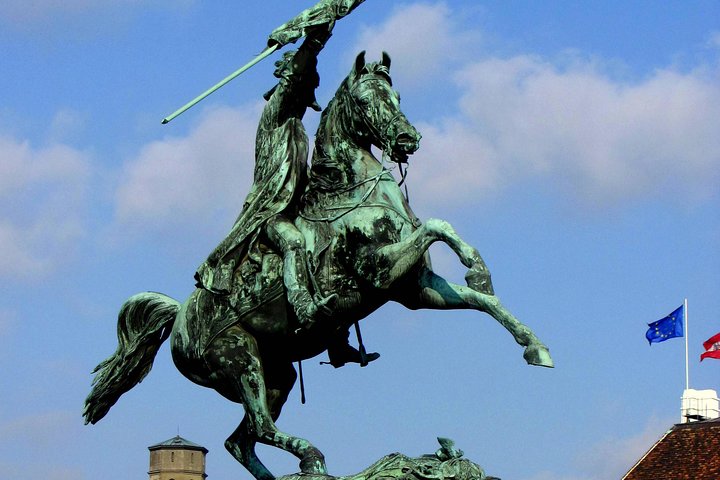
A stage for imperial ceremony, military pride, and — in March 1938 — Hitler’s Anschluss speech. Today the square is framed by parliament, city hall, museums, and the Burgtheater: a panorama of power, culture, and the fragility of both.
15 minutes • Admission ticket free -
6The Hofburg
A palace-city that served as the seat of power for seven centuries. From dukes to emperors to the modern presidency — the building embodies Austria’s long arc from monarchy to republic.
15 minutes • Admission ticket free -
Graben and Kohlmarkt (Pass by)
Where imperial façades meet ecclesiastical grandeur and today’s luxury boutiques. A reminder that Vienna has always balanced ceremony, commerce, and spirituality.
Admission ticket free -
7Judenplatz Holocaust Memorial
On the site of Vienna’s medieval Jewish community — destroyed in 1421 — stands the “Nameless Library,” commemorating the 65,000 Austrian Jews murdered in the Shoah. A quiet, essential stop.
15 minutes • Admission ticket free -
8Colonna Della Peste (Pestsaule)
The Plague Column: the Counter‑Reformation in marble, using art and devotion to reclaim a city after crisis.
5 minutes • Admission ticket free -
9St. Stephen's Cathedral
St. Stephen’s Cathedral Vienna’s Gothic heart. In April 1945, parts of the cathedral burned when looters set fire to nearby shops — a tragic end to a war that had already cost the city so much.
10 minutes • Admission ticket free
Additional info
- Service animals allowed
- Public transportation options are available nearby
- Not recommended for travelers with poor cardiovascular health
- Travelers should have at least a moderate level of physical fitness
- Pets are not permitted in certain areas visited
Tags
Cancellation Policy
For a full refund, cancel at least 24 hours before the scheduled departure time.
Cancellation Policy
- For a full refund, you must cancel at least 24 hours before the experience’s start time.
- If you cancel less than 24 hours before the experience’s start time, the amount you paid will not be refunded.
- Any changes made less than 24 hours before the experience’s start time will not be accepted.
Rating

You can cancel up to 24 hours in advance of the experience for a full refund.
Your guide to the flawless travel experience
Popular Countries
Get our app

