Share this tour



Offered languages
- English
Private 2 day tour to see the best monuments of the ancient East and West Bank in Luxor. These monuments include Valley of the Kings (Necropolis of Thebes), Temple of Hatshepsut (Deir el Bahari), V the Temple of Medinat Habu (Temple of Ramses III), the Colossi of Memnon Karnak, Luxor Temples.
What's Included
Meeting and pickup
Please contact us for exact pickup time and location (contact details will be provided on your
voucher) after booking.
Itinerary
-
1Valley of the Kings
the Valley of the Kings, the ancient Necropolis of Thebes, which is a must-see for Luxor travelers. There you visit three tombs: the Tomb of Ramses, the Tomb of Horemheb and the Tomb of Merenptah. Your Egyptologist tour guide will be with you to answer any questions you may have.
2 minutes • Admission ticket included -
2Tomb of Ramses III
The tomb of Ramesses III, designated as KV 11, is a complex system in the Valley of the Kings. It has been known since antiquity,the wonderful decorations include colourful painted sunken reliefs featuring the traditional ritual texts (Litany of Ra, Book of Gates etc) and Ramses before the gods. Unusual here are the secular scenes, in the small side rooms of the entrance corridor, showing foreign tributes, such as highly detailed pottery imported from the Aegean, the royal armoury, boats and, in the last of these side chambers, the blind harpists that gave the tomb one of its alternative names: ‘Tomb of the Harpers’
25 minutes • Admission ticket included -
3Tomb of Ramses IV
The tomb of Ramses IV (KV 2) in the Valley of the Kings is rather different than most other tombs built here. This tomb is by far the most spectacular of the other tombs you will see. The hieroglyphics on the wall depict scenes from the Litany of Ra, Book of the Dead, Book of Caverns, the Book of the Heavens, Book of Amduat, and the Book of the Night. The blue and white colors on the walls inside the burial chamber are very vibrant and you can see the king's sarcophagus made of rose-colored granite. There is also a beautiful scene of goddess Nut on the ceiling, where she is depicted swallowing the sun, and it traveling through her stomach, for Nut to give birth to it.
25 minutes • Admission ticket included -
4Tomb of Merenptah
In Egyptian mythology, Ptah is the demiurge of Memphis, god of craftsmen and architects. In the or simply in its falcon form of the new deity, began to be placed in tombs to accompany and protect the dead on their journey to the West of Luxor .Tomb 8, which is located in the Valley of the Kings, was the burial place of the Pharaoh Merneptah and is the model of royal tombs Merneptah was a son of Ramesses II and Queen Isis-Nofret.the tomb was discovered by Howard Carter in 1903. Of coursethere is a material decrease in the number of lateral rooms, and a dramatic increase in the height of the corridors and rooms. He did away with the jogged axis used since the time of Horemheb and instead built the entire tomb on a single axis. Also, for the first time, the entrance was made considerably wider than earlier tombs .
25 minutes • Admission ticket included -
5Temple of Hatshepsut at Deir el Bahari
After visiting the tombs you will be transported to the Temple of Queen Hatshepsut (Deir el Bahari), the only woman ever to reign over Egypt as Pharaoh. This queen was an ancestor of King Tutankhamun and belonged to the same dynasty.Temple of Queen Hatshepsut, the only woman ever to reign over Egypt as Pharaoh .
1 hour • Admission ticket included -
6Ramesseum (Mortuary Temple of Ramses II)
you visit the Temple of Ramses III (Medinat Habu). Medinat Habu consists of a palace and a town enclosed within a defensive wall. Entry is through the High Gate, or Migdol, which in appearance resembles a citadel
1 hour • Admission ticket included -
7Valley of the Artisans (Deir el-Medina)
you'll visit Valley of the Artisans (Deir el Medina) to see the houses of the workers who worked in the colorful royal tombs
1 hour • Admission ticket included -
8Colossi of Memnon
The Colossi of Memnon, the two largest ancient statues in Egypt, which date back to the era of King Amenhotep III.
10 minutes • Admission ticket included -
9
Possibility of optional Hot Air Ballooning over the West Bank (additional cost and weather permitting).
1 hour • Admission ticket not included -
10Temple of Karnak
you will be transported to Karnak Temple in the East Bank of Luxor. Karnak consists of many temples that were built over a number of years. Inside, view the Avenue of Sphinxes, Hypostyle Hall, Obelisks of Queen Hatshepsut and Tutomosis I, the Temple of Amon, the Granite Scarbeus of Amenophis III, and the Sacred Lake. Karnak is inspiring
2 hours • Admission ticket included -
11Luxor Museum
the Luxor Museum, which displays a unique collection of ancient items found in Luxor. Some items were found in Tutankhamun's tomb. You will also see the statue of Sobek, a crocodile god, and king Amenhotep III, along with several mummies.
1 hour 20 minutes • Admission ticket included -
12Luxor Temple
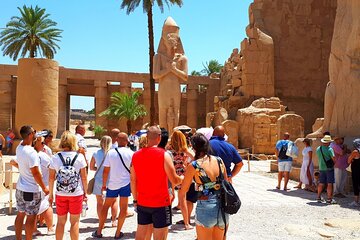
Luxor Temple, which is dedicated to the Theben Triad of Amun-Ra, Mut and Khonsu. There you will see statues of Ramses the Great
2 hours • Admission ticket included -
(Pass by)
On your first day, you will be picked up from the Luxor airport, for a 6-hour guided tour. You'll begin at the Necropolis of Thebes, a must-see for Luxor travelers. Your Egyptologist tour guide will be with you to answer any questions you may have. You'll also see the Temple of Queen Hatshepsut ,the Valley of the Artisans, and the Temple of Ramses III. Afterwards, you will be taken to see the Colossi of Memnon, the two largest ancient statues in Egypt, which date back to the era of King Amenhotep III. After touring the sites, you will be transferred back to your hotel by an air-conditioned vehicle. On day two, there is a possibility of optional hot air ballooning over the West Bank (additional cost and weather permitting). Today's
Admission ticket free
Luxor West Bank
Luxor East Bank
Additional info
- Suitable for all physical fitness levels
Tags
Cancellation Policy
All sales are final. No refund is available for cancellations.
Cancellation Policy
This experience is non-refundable and cannot be changed for any reason. If you cancel or ask for an amendment, the amount you paid will not be refunded.
Rating

You will not receive a refund if you cancel.
Your guide to the flawless travel experience
Popular Countries
Get our app